
Student loan exit counseling: Your step-by-step guide


Graduating or leaving school is a big moment, and then someone tells you that you need to complete “exit counseling” before you go. If your first thought was panic, you are not alone. Many students assume exit counseling means they owe money right now, or that they are locking themselves into a repayment plan they cannot change. Neither of those things is true. Exit counseling is an informational session designed to make sure you understand your federal student loans before repayment begins. This guide will walk you through exactly what it is, when you need it, what to expect, and how to set yourself up for success afterward.
Table of Contents
Key Takeaways
Point | Details |
Mandatory requirement | Student loan exit counseling is a required step for most federal borrowers before they leave school or change enrollment status. |
Understanding repayment | Exit counseling prepares you with essential knowledge about your loan, your servicer, and your future obligations. |
Timing is critical | You must complete exit counseling promptly—typically within 30 days—when triggered by graduation or other status changes. |
No immediate payments | Repayment does not start just because you finish counseling; there is usually a grace period. |
Opportunity to plan | Use exit counseling to understand options, but important loan decisions can be made after counseling is complete. |
What is student loan exit counseling?
Exit counseling is not a bill. It is not a contract. It is a required educational session that ensures you leave school knowing the basics of your federal student loan obligations.
Student loan exit counseling is a required informational counseling session for many federal student loan borrowers when they graduate, leave school, or drop below required enrollment status. Think of it as a final briefing before you step into the real world of repayment.
Exit counseling is not about paying your loans today. It is about making sure you know what you owe, who your loan servicer is, and what your options are before repayment starts.
Here is what exit counseling actually covers:
Your total federal loan balance and interest rates
The name and contact information of your loan servicer
Your grace period timeline (the window before payments are due)
Available repayment plans and income-driven options
Your rights and responsibilities as a borrower
Consequences of default and how to avoid them
The session is typically completed online through the official StudentAid.gov platform and takes about 20 to 30 minutes. Your school may also have its own version, but the federal session is the one that satisfies the requirement. Understanding why exit counseling is required can help you approach it with the right mindset rather than treating it as just another box to check.
When do you need to complete exit counseling?
Most students assume exit counseling is only for graduation day. That is one of the most common misunderstandings. The reality is more nuanced, and missing the requirement can create real problems.
Exit counseling requirements can be triggered multiple times during an academic career. For example, when a borrower drops below required enrollment status, loans may require updated exit counseling when the borrower’s status changes again. This means you could go through the process more than once.
Here is a breakdown of the most common triggering scenarios:
Triggering event | Who it affects | Timeline |
Graduation | All federal loan borrowers | Within 30 days of graduation |
Dropping below half-time | Students reducing course load | Within 30 days of status change |
Withdrawing from school | Students who leave mid-semester | Within 30 days of withdrawal |
Transferring to another school | Students moving between institutions | Before or at time of transfer |
Taking a leave of absence | Students pausing enrollment | Depends on school policy |
One scenario that catches students off guard is dropping below half-time enrollment. If you reduce your course load for a semester, even temporarily, your school may be required to notify your loan servicer. That notification can trigger exit counseling even if you plan to return to full-time status later. Keeping your contact information updated with both your school and your loan servicer is essential. If you miss a notification, you could miss a deadline.
Be aware of recent changes to exit counseling rules that may affect your specific situation, especially if you have loans from multiple academic periods. Also, reviewing exit counseling mistakes to avoid before you start can save you from headaches later.
Missing exit counseling can result in administrative holds on your academic records, delayed transcripts, or even complications with your loan servicer. Schools take this seriously because federal funding depends on compliance. Stay on top of student loan status updates so you are never caught off guard.
Pro Tip: Complete exit counseling as soon as your enrollment status changes, not when you get around to it. Set a calendar reminder for the same week your status changes so the 30-day window does not slip by.
What should you expect during student loan exit counseling?
Knowing what the session looks like ahead of time makes the whole process feel less intimidating. Here is a step-by-step walkthrough of what you will actually do.
The counseling explains borrowers’ rights and responsibilities and prepares them to repay, typically by reviewing loan balances, servicer information, grace-period timing, and repayment options. The session is interactive, meaning you will answer questions and confirm your understanding as you move through it.

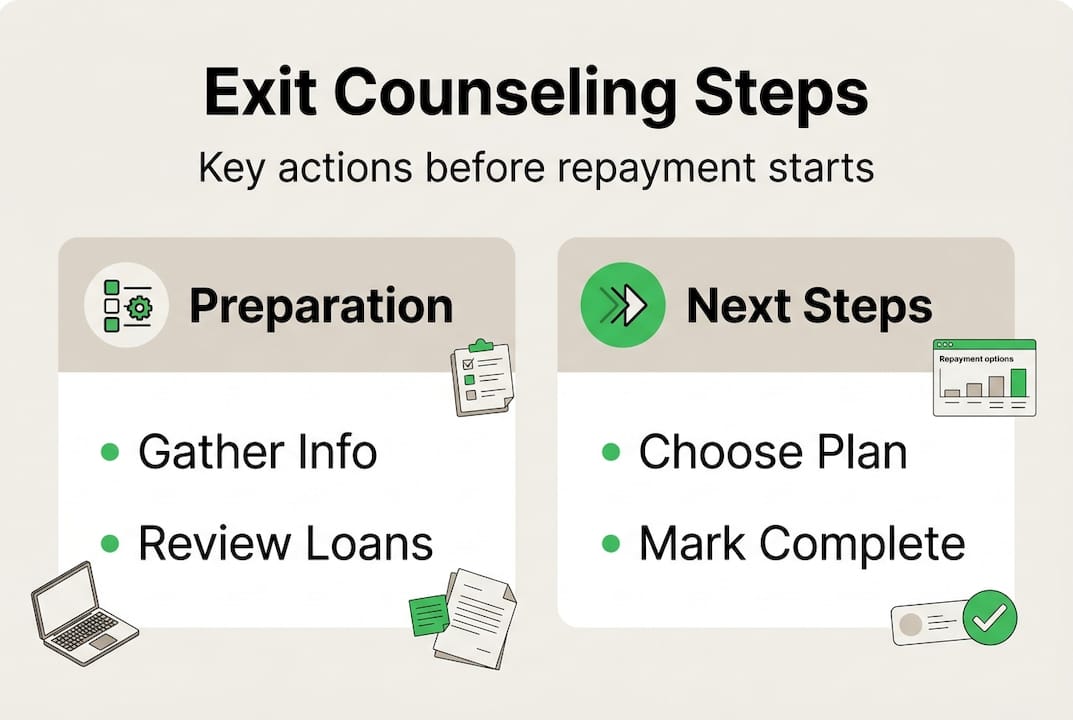
Before you start, gather the following:
Gather your FSA ID and login information and be ready to review specific federal loan balances and your updated contact information so you do not miss servicer communications after leaving school.
Here is a numbered checklist to prepare:
Log into StudentAid.gov to locate your FSA ID and password. You will need this to access the official exit counseling module.
Review your loan summary. Your total federal loan balance, interest rates, and loan types (subsidized vs. unsubsidized) are all listed in your StudentAid.gov account.
Confirm your loan servicer. Your servicer is the company that manages your payments. This information is also on StudentAid.gov.
Update your contact information. Make sure your current email address, phone number, and mailing address are accurate. Your servicer will use these to reach you.
Provide two references. Many exit counseling sessions ask for the names and contact details of two people who will always know how to reach you.
Complete the interactive modules. The session walks you through repayment plans, income-driven repayment options, and what happens if you miss payments.
Save your completion confirmation. Screenshot or print the confirmation page. You may need this if your school’s financial aid office asks for proof.
You do not have to choose a repayment plan during exit counseling. The session is designed to inform you, not lock you in. You will have time after your grace period to select the plan that fits your situation.
The session also covers how exit counseling prepares you for repayment by explaining what income-driven repayment plans look like and how changes to repayment plans may affect your options going forward. If you feel uncertain after the session, that is completely normal. Getting personalized loan counseling help can fill in the gaps.
Pro Tip: Do not rush through the repayment plan section just to finish the module. Take notes on the plans that seem most relevant to your expected income. You will thank yourself later when it is time to actually choose.
What does and does not change after exit counseling?
This is where a lot of confusion lives. Students finish exit counseling and wonder: am I in repayment now? Do I owe money this month? The answer is almost always no, not yet.
Exit counseling does not itself put loans into repayment. Repayment generally begins after the borrower is no longer enrolled at least half-time and after any applicable grace period ends. For most Direct Loans, that grace period is six months after you leave school or drop below half-time.
Here is a clear comparison of what changes and what does not:
After exit counseling | What actually changes |
You complete the session | Your school marks the requirement as fulfilled |
You review repayment plans | You are NOT enrolled in any plan yet |
You confirm your servicer | Your servicer now has your updated contact info |
Your grace period begins | Payments are NOT due yet |
You understand your balance | Your balance does not change based on counseling |
Exit counseling is primarily about understanding repayment and options. It is not a lock-in decision tool. Students should use it to understand repayment plans and then choose or act once repayment begins, or when they update their plan.
Here is what you should do immediately after completing exit counseling:
Save your loan servicer’s name, website, and contact number somewhere easy to find
Note the exact date your grace period ends (your servicer can confirm this)
Bookmark your servicer’s online portal and set up an account if you have not already
Research understanding repayment options so you can make an informed choice before payments begin
Check for any potential changes in payments that may affect your planning
The grace period is your window to get organized. Use it wisely.
Next steps after exit counseling: Setting yourself up for repayment success
Exit counseling gives you the information. What you do with it is what actually matters. Here is a practical action plan to follow after you complete the session.
The counseling reviews loan balances, servicer information, grace-period timing, and repayment options, but it is up to you to act on that information. Here is how to do that effectively:
Verify your loan servicer. Log into StudentAid.gov and confirm which servicer holds your loans. Contact them directly to confirm your grace period end date.
Mark your repayment start date on your calendar. Set a reminder two weeks before your first payment is due so you have time to finalize your plan.
Compare repayment plans. Use the Loan Simulator tool on StudentAid.gov to see what your monthly payment would look like under different plans based on your expected income.
Enroll in income-driven repayment if needed. If your starting salary will be lower than your loan balance, income-driven repayment can keep your payments manageable.
Set up autopay. Most servicers offer a small interest rate reduction (typically 0.25%) when you enroll in automatic payments. It also protects you from missing a payment.
Explore forgiveness programs. If you work in public service, teaching, or a nonprofit, you may qualify for federal loan forgiveness programs that can reduce or eliminate your balance over time.
Create a monthly budget. Factor your loan payment into your monthly expenses before you commit to other financial obligations.
Pro Tip: Set three calendar reminders related to your loans: one for your grace period end date, one two weeks before your first payment, and one for your annual income recertification if you are on an income-driven plan. These three dates can protect your credit and your financial stability.
What most exit counseling guides don’t tell you
Here is the honest perspective that most official resources leave out.
Exit counseling modules are built to satisfy a federal requirement, not to fully prepare you for the realities of managing student loans after graduation. They cover the basics well, but they tend to present repayment as a straightforward process. Your actual experience will likely be messier.
Many graduates treat exit counseling as a one-time task and then forget about their loans until the first bill arrives. That is a mistake. The students who manage their loans well are the ones who stay engaged. They check their servicer’s portal monthly, read emails from their servicer, and reach out for help before a problem becomes a crisis. Avoiding overlooked student loan mistakes means staying proactive, not reactive.
The repayment plan section of exit counseling can also feel rushed. You are shown several options and asked to absorb a lot of information in a short time. Do not feel pressured to make decisions during the session. The counseling is informational. You have time after your grace period to choose the right plan, and you can change plans later if your situation shifts.
One more thing that official guides rarely say: loan policies change. Repayment programs that exist today may look different in a year. Income-driven repayment rules have shifted multiple times in recent years. Staying informed is not optional if you want to make the best decisions for your financial future. Bookmark reliable sources, follow updates from your servicer, and do not assume that what you learned in exit counseling will remain accurate forever.
The most important thing you can do is treat your student loans as an ongoing responsibility, not a one-time event. Check in regularly, ask questions when things change, and get help before you fall behind.
How TitanPrep can help with loan repayment
Completing exit counseling is a great first step, but it is rarely the last thing you need to do.
TitanPrep is a third-party service that helps recent graduates and current students navigate student loan repayment and forgiveness programs with confidence. If you finished exit counseling and still feel uncertain about your options, or if your financial situation has changed and you are not sure what to do next, TitanPrep can help you find clarity. You can get expert help with student loans through personalized guidance tailored to your specific loan situation. If you think you may qualify for forgiveness, TitanPrep can also help you explore forgiveness options and understand the steps involved. You do not have to figure this out alone.
Frequently asked questions
Is student loan exit counseling mandatory for all borrowers?
Federal exit counseling is required for most federal student loan borrowers when they graduate, leave school, or drop below half-time enrollment. Private loan borrowers may have different requirements depending on their lender.
Will I start repaying my student loans immediately after exit counseling?
No. Exit counseling does not put loans into repayment. Repayment begins after you leave school and any applicable grace period ends, which is typically six months for Direct Loans.
Can exit counseling be completed more than once?
Yes. Exit counseling can be triggered multiple times during your academic career, such as when your enrollment status changes more than once, so you may need to complete it again in certain situations.
What information do I need to start exit counseling?
You will need your FSA ID, updated contact details and loan balances ready before you begin, along with the names and contact information of two personal references.
Recommended
Comments